
On this page +
If you need software that answers the phone, takes a booking, or talks a user through your product, you need more than a chatbot with a voice attached. A voice agent has to listen, decide and reply fast enough to feel like a conversation, and it has to cope when people interrupt it.
That is the work I do. This page explains what goes into it, what I’ve built, and how to tell whether you need a developer at all.
What does a voice AI agent developer actually build?
A production voice agent is a real-time system with several moving parts, and each one can break the call.
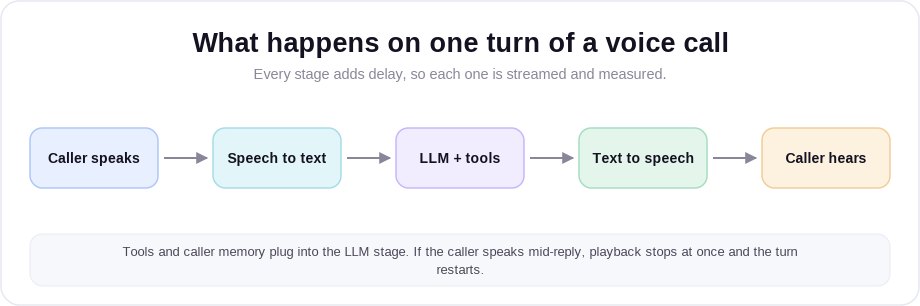
| Layer | What it does | Tools I use |
|---|---|---|
| Audio and telephony | Connects phone calls or browser audio | Telnyx, WebRTC, LiveKit |
| Orchestration | Runs the pipeline and handles interruptions | Pipecat |
| Speech to text | Turns the caller’s words into text as they speak | Deepgram |
| The agent | Decides what to say and which tools to call | OpenAI, Gemini, Groq |
| Text to speech | Speaks the reply | ElevenLabs, Kokoro |
| Speech-to-speech (alternative) | One model handles listening and talking | Gemini Live |
What voice agents have I built?
These are demos and open-source projects, each testing a different hard part of voice:
- Demo phone agents for a restaurant and a hotel. Built on Pipecat with Telnyx telephony, Deepgram, OpenAI and ElevenLabs. The hotel receptionist checks live room availability and creates, updates and cancels reservations. The restaurant agent remembers returning callers, answers from its menu and can send an SMS. Both handle interruptions on a real phone line.
- Ziko, an open-source desktop voice assistant. It uses Gemini Live with 11 validated tools, a custom “Hey Ziko” wake word detected on-device, and reminders that fire exactly once across restarts and sleep. The build log covers what went wrong, and the code is on GitHub.
- RepoRadio, a voice host for any GitHub repo. You talk to it about a codebase and it stops the moment you speak. It runs Groq for the LLM and Kokoro for local speech.
Do you need a developer or a hosted platform?
Often you don’t need a custom build, and it’s better to find that out early.
| Your situation | Better fit |
|---|---|
| Simple FAQ or call routing, testing demand | Hosted voice platform |
| Deep integration with your own systems | Custom build |
| Strict control over where data and recordings go | Custom build |
| High call volume where per-minute fees add up | Custom build, after checking the numbers |
| You need to swap speech or LLM vendors freely | Custom build |
If a hosted platform covers your case, use it, and come back when you outgrow it.
What makes a voice agent feel natural?
Mostly speed and manners, in that order.
- Latency. Replies under about 500ms feel conversational. Past that, callers start talking over the agent. The architecture guide breaks down where the time goes.
- Interruptions. When the caller speaks, the agent must stop immediately and listen. This is called barge-in, and demos often skip it.
- Honest actions. An agent must never say “you’re booked” before the booking has actually saved. Ziko follows this rule: no success message until the change is committed.
- Graceful failure. Bad audio, a slow API or an unclear request should lead to a clarifying question or a handoff, not silence.
What should you ask before hiring one?
These questions separate people who have shipped voice from people who have only watched a demo:
- What happens when a caller interrupts mid-sentence?
- How do you measure latency, and at which stage?
- How do you test the agent before real callers reach it?
- What does the agent do when a tool call fails?
- Why this speech-to-speech model or this pipeline, for my use case?
- Can I see one running and try to break it?
Ask me these too.
How does a project run?
- Scope. We agree on the calls the agent must handle, your systems, and how success gets measured.
- Prototype. A working agent you can talk to, usually in 1 to 2 weeks.
- Production. Integrations, telephony, testing and monitoring, typically 4 to 8 weeks in total.
- Handover. Docs and a walkthrough, plus an optional support window once real callers arrive.
You get a clear proposal with milestones and a price before any build starts. See all AI engineering services, or tell me about your project.
Sources & further reading
// faq
Frequently asked questions
What does a voice AI agent developer do?+
They design and build the real-time system behind a voice agent: telephony or browser audio, speech-to-text, the LLM and its tools, text-to-speech, interruption handling, and the logging and testing that keep it reliable once real callers use it.
Should I use a hosted voice platform or hire a developer?+
Start with a hosted platform if your flow is simple and you want to test demand quickly. Hire a developer when you need deep integration with your own systems, control over each vendor, data handling a platform can't meet, or per-minute costs that matter at your volume.
How long does it take to build a voice AI agent?+
A working prototype usually takes 1 to 2 weeks. A production agent typically takes 4 to 8 weeks, depending on integrations, telephony setup and how much testing the use case needs.
Which is better for voice agents, Pipecat or a speech-to-speech model?+
It depends on the job. A pipeline such as Pipecat with separate speech and language models gives more control and a transcript at every stage, while a speech-to-speech model can sound more natural. My architecture guide compares them in detail.
Can a voice agent use my business data and tools?+
Yes. The LLM stage can call tools that read and update your systems, such as bookings or a CRM, and can remember returning callers. The important part is validating each action, so the agent never tells a caller something succeeded when it didn't.
Are AI voice calls legal in the US?+
Inbound agents are generally simpler, but outbound calls carry real obligations. The FCC ruled in 2024 that AI-generated voices count as artificial under the TCPA, so outbound calls generally need prior consent. Get legal advice for your own use case before launch.